


Last night, Art Toronto opened its twenty-seventh edition at the Metro Toronto Convention Centre, and starting today the fair opens to the public through Sunday. One hundred five exhibitors: fifty-five main galleries, sixteen Verge galleries for spaces under a decade old, eight solo presentations, eleven Arte Sur galleries, and fifteen arts and cultural institutions.
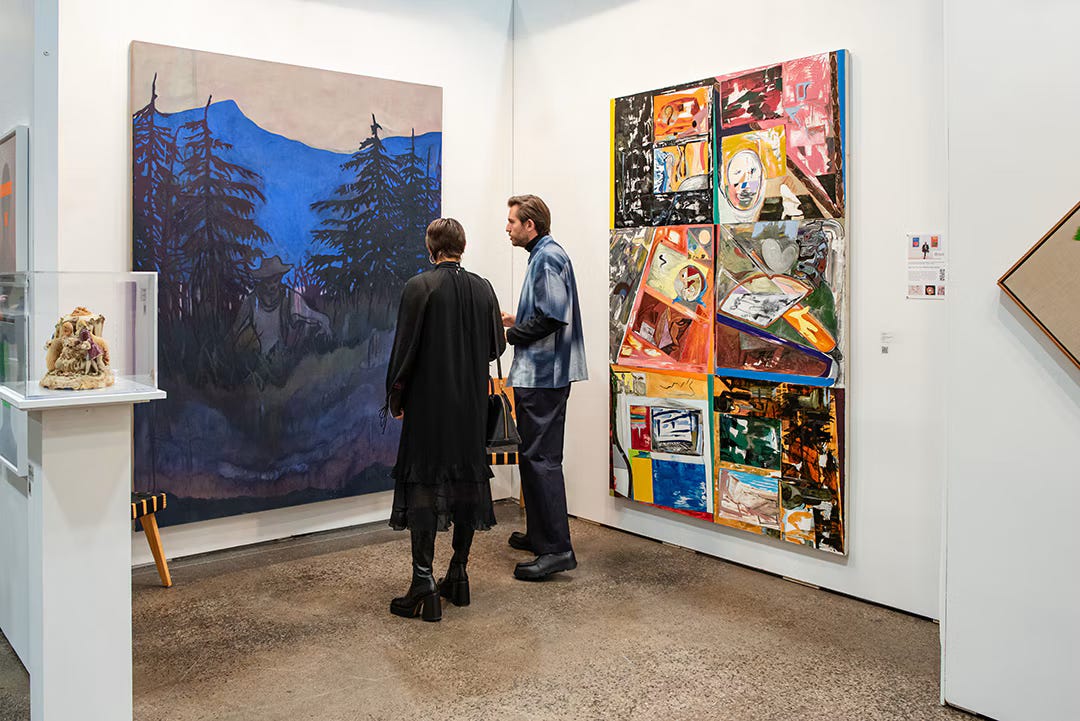
This is the first edition under a new director, Emily-Jean Alexander, and she has said plainly what she is after: “for my first Art Toronto, I wanted to think about what it means to build the future of an art fair, and for me, that starts with the next generation of collectors. Canada has extraordinary artists, galleries and institutions, but a strong art market also depends on people feeling that collecting is something they can participate in.”
Hence the Friday Emerging Collectors Evening, with advisor-led tours and DJs, aimed at people beginning or expanding a collection. Hence the talks and guided tours folded into the ticket price. The fair is trying to lower the velvet rope.
The program is worth noting in full. Arte Sur returns for its second edition, curated by Karen Huber, with eleven galleries from Mexico, Central and South America, New York and Toronto. The Solo section comes back after a six-year absence, with focused presentations including Ursula Johnson, Audie Murray and Don Yeomans. Nearly a third of the participating galleries are showing work by Indigenous artists.
And the headline object: Edward Burtynsky’s Vault Collection, presented by the Nicholas Metivier Gallery. Rare photographs spanning 1985 to 2016, artist proofs from his own archive, legacy prints of early works, and the world premiere of two new photographs from his forthcoming project, Mining: For the Future, made on a 2025 trip to Western Australia, documenting the extraction of lithium, copper and cobalt for emerging energy technologies.
One more fact with an address. Last night’s opening was a benefit, and every ticket supported the McMichael Canadian Art Collection, the country’s only public gallery devoted exclusively to Canadian and Indigenous art, now in the middle of the most significant redevelopment of its building and grounds in more than forty years.
So much for the facts. Now the question they raise, which is the one Alexander has put at the center of her fair: what is a collector, and how is one made?
In The System of Objects, Jean Baudrillard distinguishes what happens to an object in its technological function — what he calls essential to the object — from what happens in its psychological or sociological dimension, which he calls inessential. The essential is denotative; the inessential is connotative. When we interact with an object by adding cultural or psychological values to it, we situate it in the space of its inessential characteristics: the object connotes what we project onto it.
Collecting is the purest form of that operation. Nobody buys a painting for its technological function. The collector buys the connotation: the prestige, the memory, the lineage, the idea of a life, and arranges it in space. A fair like Art Toronto is, among other things, a school for that projection: it teaches visitors which connotations are available, which are scarce, which are about to appreciate.
That is why the director’s bet is so interesting. The market, left to itself, concentrates: the same names, the same proven values. Alexander is arguing that the fair’s future depends on people who cannot yet afford it, on teaching a new generation to project. That is the strategy. The market needs new buyers the way a mine needs new veins. And Burtynsky, the great chronicler of industrial extraction, presides over the whole affair as its trophy object: the fair converts attention into price, and it is learning, out loud, how to recruit the next shift of converters.
But there is a deeper sense in which the fair has always been a school, and it concerns memory. In the Rhetorica ad Herennium, the treatise attributed to Cicero, memory is “the guardian of all the parts of rhetoric”. Cicero separates natural memory, the capacity born with thought, from artificial memory, which is strengthened by training. Artificial memory is composed of backgrounds and images: mental scenes in which we dispose the images we wish to remember, figures or portraits set within a bounded spatial frame. The collector’s house, the collector’s gallery, the collector’s museum: all of them are artificial memories made physical. They are palaces of memory.
Mexico’s private museums taught me this twenty years ago, when I wrote about them at length. Consider the Museo Bello y Zetina in Puebla, opened in 1944: the collector José Luis Bello y Zetina arranged his paintings — Murillo, Zurbarán, Goya, Miguel Cabrera — alongside his sculptures and furniture so that the visitor would understand, room by room, how a well-to-do Mexican family of the early twentieth century lived. The house was exhibited as a model: not so that the public could acquire the objects, but so that it would take the arrangement as a model of how objects function, the exact principle Baudrillard attributes to high-society interior magazines. Walking those rooms, you attend a spatial discourse that preserves in your memory a knowledge of social behaviors, daily practices, and canons of visuality. The collection is a rhetorical argument about taste.
Or consider the Museo Franz Mayer, opened in 1986 from the collection of a German collector who had spent decades acquiring objects in Mexico and the world like textiles, furniture, religious objects, chosen for their manufacture, their materials, their original use. There the memory leaves the personal house behind and organizes itself into categories; it is classification that sustains memorization, a didactic discourse of the applied arts. The objects have an essential, utilitarian structure, but their inessential value is manifest in the vitrines and the rooms. Two foreigners living in Mexico gave body to the aesthetic aspirations of the Mexican bourgeoisie.
Now look at Art Toronto with those cases in mind. The fair is a Franz Mayer that lasts four days: its sections — Main, Verge, Solo, Arte Sur — are categories that sustain memorization. Its booths are Bello y Zetina’s rooms, compressed into ten-by-ten feet: models of arrangement that teach the visitor how objects function together, how a collection might look, how a life might be furnished with meaning. Every fairgoer walks out with an artificial memory they did not have when they walked in. The only question is what that memory has been trained to retain and by whom.
Because collections are never innocent, and the most instructive Mexican case is the most recent one. Eugenio López, heir to an important fortune, began collecting in 1994 and became Mexico’s most important collector of contemporary art. To protect his investment he hired a team of curators who guided his purchases, an apparatus of collecting that first became a gallery on the grounds of the Jumex factory in Ecatepec in 2001, then the Museo Jumex in Polanco, now the most important institution for the diffusion of Mexican contemporary art, programmed by the British curator Kit Hammond with the explicit idea of inscribing the museum in global circuits. López became the model of the intellectual-fashion discourse: the man who can collect what no one can acquire, and who, by showing it, makes clear to his audience that his idea is a new norm, a new model, in Baudrillard’s sense, that validates a generation. The collection is an expression in which the object represents a value based on an inessential characteristic, but one that expresses clear forms of taste and conduct. It is a narcissistic expression that allows its replica in every object, where the preeminence of the object can be confused with that of the collector.
That is the operation Alexander is attempting at Art Toronto, in commercial dress. The advisor-led tours of the Emerging Collectors Evening are Jumex’s curatorial apparatus, miniaturized and democratized: someone to guide the purchase, someone to validate the taste, someone to tell the new collector that their idea is a new norm. The DJs are the tell; the fair knows it is recruiting. The only honest question is whether it is recruiting collectors or customers: whether the new generation will learn to project its own values onto objects, or merely to repeat the projections the market has already priced.
There is a precedent for the hopeful version. In the 1990s, the Museo de Arte Moderno’s Carrillo Gil collection, the most important group of easel paintings by Rivera, Siqueiros and Orozco, awarded the International Prize at the 1949 Venice Biennale, changed its vocation and became the center of Mexican contemporary art activity, receiving the young artists of the nineties generation and linking them to the international scene of curators and museums. The museum’s director at the time, the late Osvaldo Sánchez, said the turn answered two forces: a generation of artists producing a significant quantity of quality work on criteria different from their predecessors’, and the emergence of a young public that sought to integrate socially with that group of artists; a public that followed the activity of a group expressing its aspirations of modernity and cosmopolitanism. The Museo Amparo in Puebla did the same thing from the other end: a colonial and nineteenth-century collection expressing the conservative values of Mexican society, crowned with a major collection of nineties artists, validating the new generation’s discourse by placing it inside the museum’s line of continuity.
That is the real prize Alexander is chasing: not the sale, but the young public. A generation that seeks to integrate with the artists, that follows the activity of a group expressing its aspirations. The fair can mint collectors the way the Carrillo Gil minted a scene, or it can simply process transactions. The Emerging Collectors Evening will tell us which, and so will the attendance figures on Sunday.
In my 2021 essay on these museums (my apologies for the self-reference), I argued that the operation of discovering objects in a collection is equivalent to the way literary essays are composed, especially in Mexico. For Montaigne, to essay is to wander; the essay is unstructured, exploratory, tending to find in the corridors of thought images or ideas that crystallize and relate to others along the route. The Mexican essayistic tradition, Torri, Paz, Monsiváis, answers to that almost accidental wandering more than to the systematization that seeks to fix knowledge didactically. Their texts are walks through the galleries of their own collections of images. It is no surprise that both Paz and Monsiváis were collectors. The essayists structure their wanderings in routes comparable to galleries with personal collections.
A fair is an essay you walk through. The visitor divagates: from a Burtynsky proof to an Ursula Johnson basket, from Arte Sur to a Verge booth, finding in the corridors images that crystallize and relate to others along the route. The Solo section, returning after six years, is the fair’s most essayistic gesture: a single voice, a single constellation, held long enough to be read. Walter Benjamin, writing on book collecting, observed that books in a library are not always read; they group together to form an expression of the collector’s thought, articulating themselves in space through their relation to one another. The fair’s booths work the same way: objects resignified in the ensemble, acting differently in time, like ideas we keep in memory; a catalogue of images in backgrounds that we unveil in thought.
And across town, the rival machinery is running. On Wednesday, the Canada Council for the Arts announced the finalists for the ninetieth Governor General’s Literary Awards; the winners to be named November 12. In fiction: Kim Fu, Sharon Bala, Sara Peters, Kaye Cayley, Nina Dunic, the last two from small presses. In poetry: Brandi Bird, nominated twice in three years, and Kaie Kellough. In nonfiction: Miriam Toews, and a memoir titled like a flare, You Will Not Kill Our Imagination: A Memoir of Palestine and Writing in Dark Times. Two weeks ago the Giller Prize handed its jury to nine independent booksellers for the first time; one theory of judgment: let the people who sell books decide what books are worth. The Governor General’s are the rival theory: peer juries, writers judging writers, the state administering the crown. The bookseller asks what moves. The peer jury asks what lasts.
The market machinery concentrates. The prize machinery, at its best, disperses. Tonight, at the convention centre, value is whatever a buyer will pay — whatever connotation the new collectors have learned to project. At the Canada Council, value is whatever a jury of peers will defend.
Three machineries for deciding what art is worth: the fair, the prize, the anthology. This week, all three are running at full speed in Toronto. The fair’s wager is the boldest of the three, because it is the only one that admits it needs to manufacture its own future: a generation of collectors who do not yet exist, learning, booth by booth, tour by tour, to remember what they have been taught to want. Whether they learn to want their own things, or only the market’s, is the question the next edition will have to answer.